How Restaurants and Food Brands Get Professional Food Photos Without Hiring a Photographer

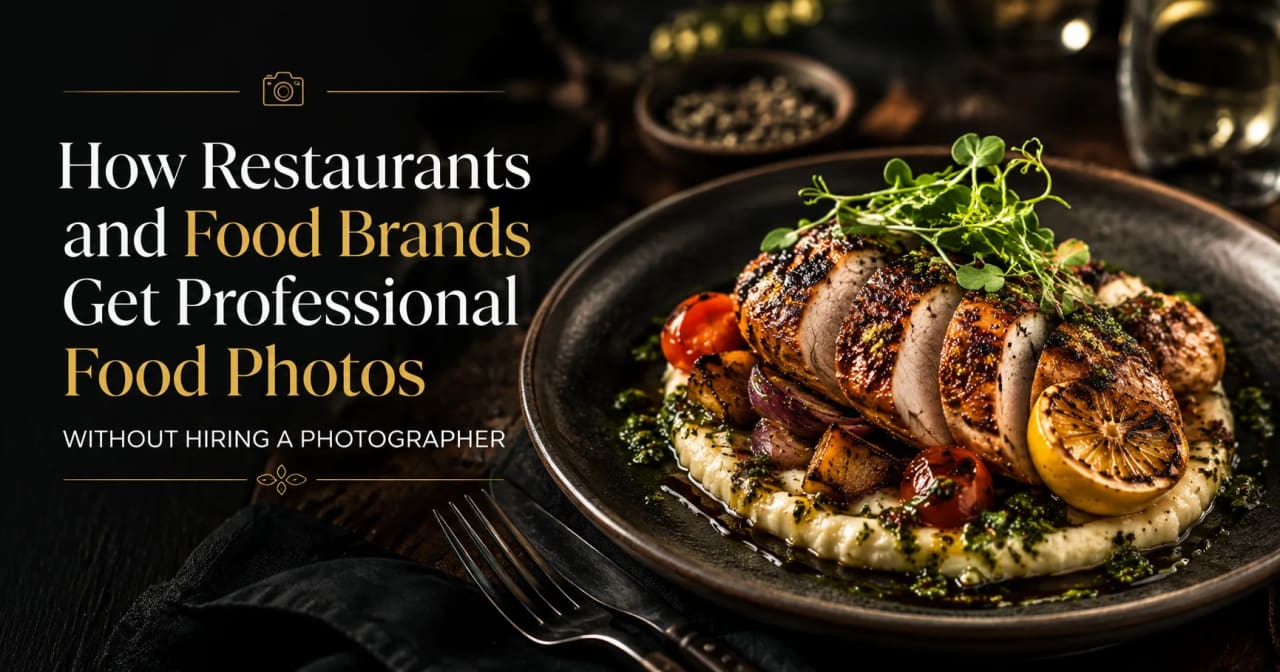
How Restaurants and Food Brands Get Professional Food Photos Without Hiring a Photographer
The most expensive thing on your menu might not be what you think.
It is the items that look unappetising in your photos. Every dish that looks flat, poorly lit, or unappetising on your Talabat listing, your Instagram, or your Google profile is a dish that does not get ordered.
Food businesses lose revenue every day not because their food is bad — but because their photos do not show it properly.
This guide is about fixing that. Practically, affordably, and without booking a food photographer every time something changes on your menu.
Why Food Photography Directly Affects Orders
Food buying decisions are almost entirely visual. When a customer opens a delivery app and sees your menu, they are not reading ingredient descriptions. They are looking at the photos and deciding within seconds whether they want what they see.
Research consistently shows that menus with professional food photography generate significantly higher order values than those with basic or no photography. On delivery platforms, listings with high-quality hero images receive more clicks. More clicks mean more orders. More orders mean more revenue.
The same principle applies to Instagram and social media. A food post that makes someone hungry generates engagement. A flat, dull photo of the same dish gets scrolled past.
This is not about vanity. It is about revenue.
The Problem with Booking a Food Photographer
Food photography is a specialist field. The best food photographers understand styling, lighting, propping, and how to make food look as good as it tastes. When it is done well, it is worth every riyal or dirham.
The challenge is that professional food photography is expensive, and menus change.
For a restaurant that updates its menu seasonally, adds weekly specials, or launches a delivery-only menu, the economics of hiring a photographer each time do not work. A full food photography day produces beautiful images — but the moment the menu changes, those images are outdated.
For smaller food businesses — a home chef, a catering operation, a specialty food brand launching a new product — booking a professional photographer represents a significant upfront cost that can be difficult to justify before the revenue is there.
The result: most restaurants and food businesses operate with a mixed set of visuals. Some dishes have good photos. Some have bad ones. Some have none at all. The overall presentation is inconsistent, which undermines trust with every potential customer who browses the menu.

What Good Food Photography Actually Looks Like
Understanding what separates effective food photography from ineffective food photography helps in evaluating any visual content decision.
Lighting: Food photography relies heavily on directional light — usually side or back lighting — that creates depth, highlights texture, and makes the food look dimensional rather than flat. Overhead bright light, which is how most restaurants are lit, produces flat, uninspiring photos.
Styling: Professional food photography involves arranging the food carefully, cleaning up edges and spills, positioning garnishes intentionally, and making the dish look like the best version of itself. This is called food styling, and it is a skill in its own right.
Surface and background: The surface the food is placed on contributes significantly to the mood. Dark wood creates warmth and richness. White marble reads as premium and fresh. Raw concrete feels contemporary. Coloured backgrounds shift the entire personality of the image.
Composition: Where is the camera positioned? What is in focus? What is slightly out of focus in the background? What is included in the frame and what is left out? All of these are deliberate decisions in effective food photography.
Post-production: Even great food photography requires careful editing — colour correction, contrast adjustment, and retouching to remove distracting elements.
When these elements are done well, the result is a photo that makes the viewer hungry. When they are not, even excellent food looks mediocre.
How Food Businesses Are Getting Quality Food Visuals Without Constant Photo Shoots
The approach that is working for a growing number of food brands and restaurants is a production process that creates professional-quality food visuals from reference material — without requiring a full photoshoot for every new dish or product.
In practice, this means:
You provide reference material. Clear, well-lit photos of the dish or product — taken with a smartphone in good lighting. These do not need to be professional. They need to be clear enough to show what the food looks like.
A brief is created. The style of photography — the surface, the lighting treatment, the mood — is defined based on your brand, your target platform, and the context (delivery app, Instagram, menu print).
Professional food visuals are produced. Each dish is rendered as a complete, professionally styled food photograph, with appropriate lighting, surface, composition, and mood.
You receive ready-to-use files. Delivered in the formats needed for delivery app listings, social media, your website, or print menus.
This works for:
- Delivery platform listings (Talabat, Deliveroo, Careem Food, Hungerstation)
- Instagram and social media content
- Printed and digital menus
- Brand campaigns for food products
- Social media advertising
Practical Use Cases
A restaurant updating its Talabat listing The restaurant has 25 items on the delivery menu. Half have no photos, and the ones that do are from a phone camera in the restaurant kitchen. A full set of professional food visuals is produced from clear reference photos for each dish — without a photographer, without a styling day, and in less than a week.
A home chef or catering business launching online orders The business is moving from word-of-mouth to a structured online presence. Professional food photography is needed before the launch but before revenue justifies a full shoot. A set of launch-ready food visuals is produced affordably.
A packaged food brand launching a new product The product is a new sauce, condiment, or food item going onto shelves or into an online store. Both product packaging shots and food photography showing the product in use are needed. Both can be produced through the same brief process.
A restaurant refreshing for Ramadan The existing menu photos are neutral year-round visuals. For Ramadan, the brand wants a warmer, more celebratory mood — golden lighting, richer backgrounds. Seasonal versions of key dish images are produced without a new shoot.
Key Advantages for Food Businesses
Affordable enough to update regularly. You can refresh your visuals when the menu changes, not just once a year when the budget allows.
Fast turnaround. New dish photos in three to five days, not three to four weeks.
Consistent across the entire menu. Every dish photographed in the same style, on the same surfaces, with the same lighting treatment. The menu looks like a unified brand, not a collection of different shoots.
Platform-ready. Files delivered in the exact dimensions and specifications for Talabat, Deliveroo, Instagram, and other platforms.
Honest Limitations
This approach works best for dishes with clear, defined visual presentation. For very complex plated dishes where the chef's specific technique is central to the presentation, physical food photography may still produce the most precise result for certain images.
High-quality reference photos improve the output. A clear, well-lit smartphone photo in natural or window light is sufficient. A very dark, blurry reference will produce a less accurate result.
FAQ
Conclusion
Your food is good. Your customers just need to see that before they order.
Inconsistent, low-quality food photos are one of the most fixable problems in a food business — and one of the highest-return improvements you can make to your delivery listings, your social media, and your overall brand.
You do not need to wait for a photographer to become available. You do not need a full menu photoshoot budget. You need a fast, reliable process for producing food visuals that make people hungry.
Get Your Menu Looking the Way Your Food Deserves
See food photography examples →
Or explore:
Ready to Elevate Your Brand's Visuals?
Stop losing sales to poor product photography. Let's create stunning, high-converting AI visuals for your next campaign.