
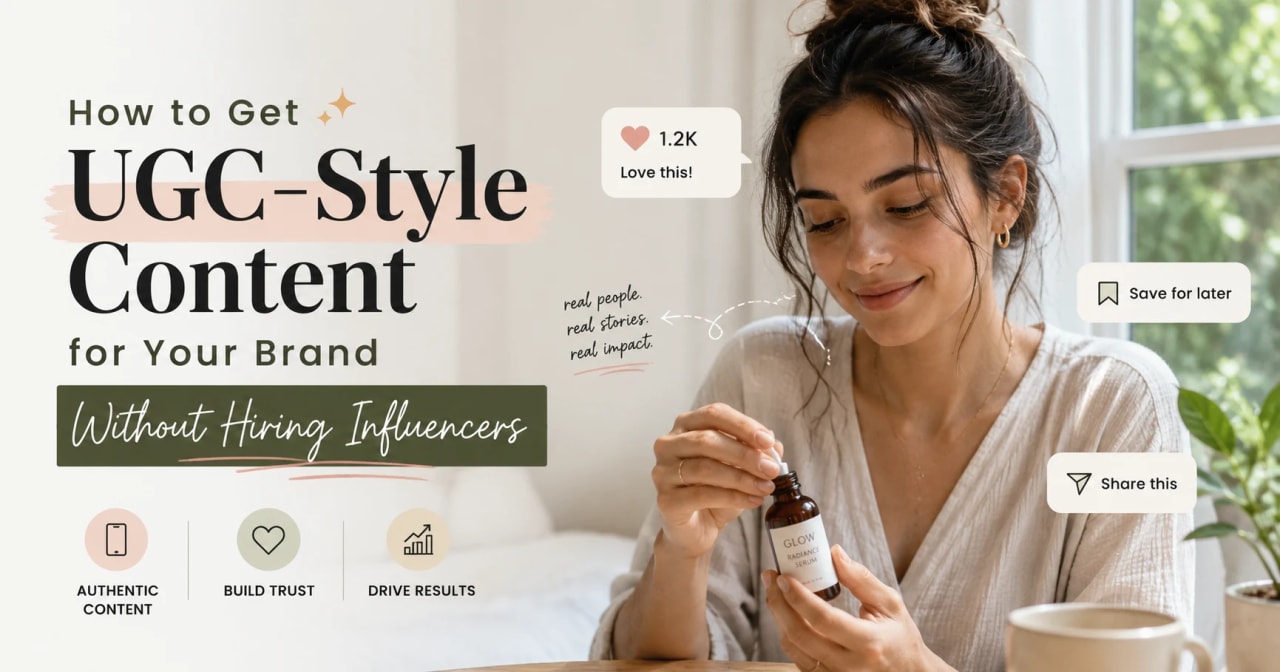
How to Get UGC-Style Content for Your Brand Without Hiring Influencers

How to Get UGC-Style Content for Your Brand Without Hiring Influencers
If you have been running Meta or TikTok ads in the last two years, you have probably been told the same thing by your media buyer, your marketing consultant, or anyone who follows advertising trends:
You need UGC content.
User-generated content — the casual, unpolished, authentic-looking video or photo of someone actually using your product — consistently outperforms traditional polished brand advertising in paid campaigns. Studies show UGC ads achieve higher click-through rates, lower cost-per-purchase, and better overall return on ad spend than conventional brand creative.
The problem is that real UGC is hard to produce at scale. And the alternatives most brands try — hiring influencers, seeding products, paying content creators — are expensive, inconsistent, and difficult to control.
This guide explains what makes UGC content effective, why traditional approaches to getting it are failing most brands, and how to solve the problem practically.
Why UGC Performs So Well in Advertising
Understanding why UGC works helps in creating content that replicates those effects deliberately.
It does not look like an ad. The most effective UGC ads start like a regular video someone filmed on their phone. There is no polished brand intro, no logo animation, no studio-perfect lighting. The viewer does not immediately register that they are watching an advertisement, which means they are more likely to keep watching.
It feels like a recommendation, not a pitch. When someone who looks like a real customer talks about a product, it activates social proof at a psychological level. Even if the viewer intellectually knows this is a paid ad, the format creates a feeling of peer recommendation rather than brand promotion.
It is relatable to the target audience. The best UGC content reflects the real lives of the people it is aimed at — their spaces, their aesthetic, their way of talking. When the content looks genuinely like something the viewer's social circle might post, it resonates in a way that brand content cannot.
The algorithm prefers it. Both Meta and TikTok's algorithms are designed to favour content that looks like organic social posts, because that is the content their users engage with most. UGC-style creative tends to pass through the "this is an ad" filter more effectively than polished brand content.

Why Traditional Methods of Getting UGC Are Failing Brands
Seeding products to influencers. You send the product and hope someone posts about it. Most do not. Those who do produce variable quality content over which you have no creative control. You cannot approve the script, the lighting, the framing, or the message. You may get one unusable video and a dead-end email thread.
Hiring UGC creators on platforms like TikTok Creator Marketplace or Fiverr. The quality ranges enormously. The best creators are booked and expensive. The affordable ones often produce content that looks scripted, uncomfortable, or low-quality in ways that undermine the entire purpose of UGC. Revision cycles are slow, and you often end up with something usable after three or four rounds.
Running organic UGC campaigns. Asking your real customers to post content and reposting it gives you authentic material, but you cannot control quality, consistency, or quantity. For a paid ads strategy that needs ten new creatives per month, organic UGC is insufficient.
Internal team-produced UGC. Some brands film their own UGC-style content internally. This works well for founders who are comfortable on camera or brands with a strong DIY aesthetic. For most brands, however, this requires ongoing effort, equipment, filming time, and editing — and the results are inconsistent.
What Good UGC-Style Content Actually Looks Like
For static images:
- The product is held, used, or shown in a real-looking environment — not a studio setup
- Lighting looks natural rather than professionally controlled
- The composition has an intentional imperfection — not everything perfectly centred
- The setting reflects the target customer's actual life: a desk, a bathroom shelf, a kitchen counter, a handbag
For video:
- The opening three seconds look like a personal post, not an ad
- The person looks and sounds authentic — not scripted or rehearsed
- The product appears in context of a real routine or moment
- The pacing is natural, not a brand edit
The goal is not technically poor content. The goal is content that reads as authentic — which is a distinct creative craft from polished brand photography, not simply lower quality.
How Brands Are Getting Scalable UGC Without Relying on Influencers
The approach that is working for performance-focused brands is producing UGC-style content through a controlled creative process that replicates the look and feel of authentic content — without the unpredictability of influencer campaigns.
This means producing content with AI-generated presenters and influencer-style characters — realistic, relatable figures who present the product in the way a genuine user would. The output is UGC-style video and photo content that performs in advertising with the authenticity signal of real UGC and the creative control of brand-produced content.
What you can control:
- The character and demographic of the presenter
- The script and key messages
- The visual environment and setting
- The tone — enthusiastic, casual, informative, funny
- The hook and opening three seconds
- The call to action
- Multiple versions for A/B testing
What you get:
- UGC-style video content ready for Meta, TikTok, and Reels
- Lifestyle product images that look like real customer photos
- Multiple creative variations from a single brief
- Content delivered in days, not weeks
Practical Use Cases
An ecommerce brand scaling Meta ads The brand is spending on Meta and needs a constant supply of UGC-style creative to test. Rather than managing an ongoing influencer relationship, a monthly brief produces ten to fifteen new UGC-style creatives — testing different hooks, different presenters, different settings.
A beauty brand launching a new product The launch requires social proof content before real customer reviews exist. UGC-style content is produced that shows the product being used realistically and authentically — creating the social proof signal before organic reviews have had time to accumulate.
A supplement or wellness brand with sensitive messaging Wellness brands often have messaging constraints around what can be claimed in advertising. UGC-style content with carefully briefed scripts allows the brand to communicate effectively within those constraints while still maintaining the authenticity signal that makes UGC effective.
A fashion brand with new seasonal arrivals Rather than running the same lifestyle photoshoot creative, seasonal UGC-style content shows products being worn and used in real-looking contexts — refreshed for each season.
Key Advantages
Creative control: Unlike real influencers, every element of the content — script, setting, presenter, tone — can be briefed and controlled precisely.
Scalability: Produce ten, fifteen, or twenty UGC-style creatives per month without managing creator relationships.
Testing capability: Multiple variations from a single product brief allow for systematic creative testing.
Speed: Content delivered in days, not the weeks that influencer campaigns often take.
Honest Limitations
AI-generated influencer and UGC-style content is optimised for advertising performance — it performs in paid channels. For organic social media credibility that comes specifically from real customer posts being seen on real accounts, there is no substitute for genuine customer advocacy.
For brands with a very specific niche community — where the audience knows every creator in the space — content that does not come from a recognised community member may perform less well organically. For paid advertising, this is less relevant, as the algorithm treats content based on engagement signals rather than creator identity.
FAQ
Conclusion
UGC content works because it does not feel like advertising. Getting it has historically been slow, expensive, and unpredictable.
A production process that delivers UGC-style creative on brief, in volume, on a timeline that supports an active ad account changes that equation for most brands.
If you are spending on paid social and not testing UGC-style creative, you are leaving performance on the table.
Build Your UGC Content Library
Or explore:
Ready to Elevate Your Brand's Visuals?
Stop losing sales to poor product photography. Let's create stunning, high-converting AI visuals for your next campaign.


