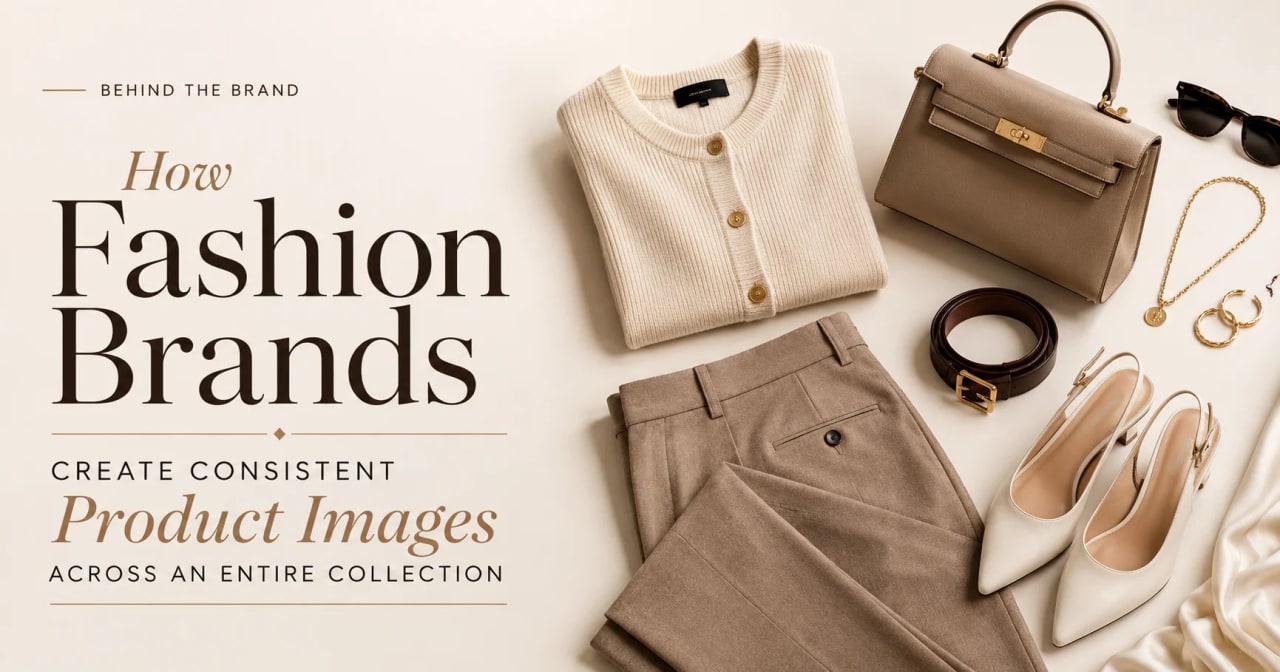
How Fashion Brands Create Consistent Product Images Across an Entire Collection

How Fashion Brands Create Consistent Product Images Across an Entire Collection
A fashion collection lives or dies on how it looks online.
You can spend months designing pieces, sourcing materials, and perfecting the fit — and then lose the sale before the customer reads a single product description, simply because your product images look rushed, inconsistent, or beneath the quality of what you have made.
For fashion brands selling on their own store, on platforms like Noon or Namshi, or directly through Instagram, visual consistency across an entire collection is not optional. It is the foundation of brand credibility.
This guide is for fashion brands and clothing labels that need to launch a new collection, maintain a consistent visual identity, and produce professional product images at the volume and speed the business requires.
The Specific Challenge for Fashion Brands
Fashion product photography faces a challenge that other categories do not have to the same degree: volume.
A skincare brand might have eight products in a range. A fashion brand can have forty to a hundred items in a seasonal collection — each needing multiple photos, in multiple formats, at consistent quality.
When you calculate what that means in terms of traditional photography, the numbers get difficult fast. A full collection shoot with a photographer, a studio, and a model can take multiple days and cost thousands of dollars. And this needs to happen every season.
For established brands with large production budgets, this is manageable. For independent labels, emerging designers, and growing fashion businesses, the photography requirement can be one of the most significant barriers between having a collection and being able to sell it.
Why Visual Consistency Matters in Fashion
Before looking at solutions, it is worth understanding why consistency matters so much in fashion specifically.
Consistency communicates intentionality. When every image in your collection shares the same lighting, the same background, the same styling approach — it tells the customer that this brand has a point of view. It was designed, not assembled. That perception supports premium positioning.
Inconsistency breaks trust. If three products look beautifully shot and the next four look like they were photographed by different people on different days, the customer starts to wonder whether the brand is real, whether the quality is consistent, and whether the price is justified.
Platform requirements demand consistency. Ecommerce platforms and marketplaces have visual standards. Product images that do not match — in background colour, in image orientation, in visual treatment — create a listing that looks unprofessional even when the individual product is excellent.
Social media amplifies the problem. On Instagram, your entire product grid is visible at once. Inconsistent product images break the visual identity of the brand with every scroll.

What a Strong Fashion Product Image Set Looks Like
For a fashion brand, a complete image set per product typically includes:
Hero product shot: Clean, consistent background — usually white or a brand-specific neutral tone. This is the primary store image. It needs to be clear, high-resolution, and distraction-free.
Lifestyle or on-figure image: The product worn or styled in context. For apparel, this means on a model or mannequin. For accessories, it means on a surface or in a lifestyle scene. This is what makes the customer want the product.
Detail image: A close-up of the stitching, the clasp, the fabric texture, the hardware. This communicates quality at the specific level where the purchase decision is made.
Multi-angle images: For apparel, front and back. For accessories, two or three angles that show the full form of the piece.
Flat lay: Many fashion brands include a styled flat lay for use in editorial contexts, look books, and Instagram content.
Producing all of these, for every item in a forty-item collection, on a consistent timeline and within a manageable budget, is the core challenge.
How Fashion Brands Are Approaching This
The most efficient solution emerging for fashion brands is a production process that does not require a studio shoot for every product or every season.
Starting from product reference images — clear photos of each item — a professional visual is produced for each piece: correct lighting, brand-appropriate background, consistent styling treatment, and all the image variants the brand needs for its sales channels.
This approach is used by fashion brands to:
Launch a full collection on time A brand has a collection of 30 pieces launching in two weeks. Booking a full shoot for 30 items in that timeline is not possible. A production process that receives product references and delivers a full image set per item within the launch window is the practical solution.
Maintain visual consistency across a growing range Every time a new product is added to the range, it needs to look like it belongs in the same collection as everything else. Producing new products in the same visual style — same background, same lighting, same composition approach — is straightforward when the process is repeatable.
Produce seasonal content without seasonal shoots A brand that sells year-round needs its product images to reflect seasonal moods — cooler tones for winter, warmer and lighter for summer, richer and more celebratory for Ramadan or Eid. Seasonal visual variants can be produced from existing product references without a new shoot.
Expand into new markets with localised imagery A fashion brand entering the Gulf market may need imagery that reflects a specific aesthetic sensibility. Localised visual treatments can be produced for different markets without duplicating the physical product shoot.
Key Advantages for Fashion Brands
Collection-scale production: A full collection can be visually produced without requiring a shoot day for every item.
Launch timeline adherence: Visual content can be delivered on a timeline that supports the collection launch date, not the photographer's availability.
Per-item cost efficiency: The cost per image decreases significantly at scale, making full-collection visual production affordable for growing brands.
Consistent seasonal refreshes: Seasonal content can be updated affordably each quarter without a full reshoot of the range.
Honest Limitations
For fashion categories where fit, drape, and movement are the primary selling points — particularly for garments where how the fabric moves on a body is the key quality signal — physical model photography remains the most effective approach for those specific shots.
This production method is particularly strong for accessories, footwear, bags, jewellery, scarves, modest fashion pieces, and apparel where the flat product appearance communicates the essential quality of the item.
For brands that need both flat product images and on-model lifestyle content, a hybrid approach is often the most practical solution — on-model physical photography for lifestyle images, production-without-shoot for product page images and catalogue content.
FAQ
Conclusion
A fashion collection is only as strong as how it looks on screen. Beautiful product images do not just photograph what the collection looks like — they communicate what the brand is.
For fashion brands that need to launch on time, look consistent, and produce content at the volume the business requires, there is a practical and affordable way to do this without rebuilding the production process every season.
Launch Your Collection Looking the Way It Deserves
See fashion portfolio examples →
Or explore:
Ready to Elevate Your Brand's Visuals?
Stop losing sales to poor product photography. Let's create stunning, high-converting AI visuals for your next campaign.