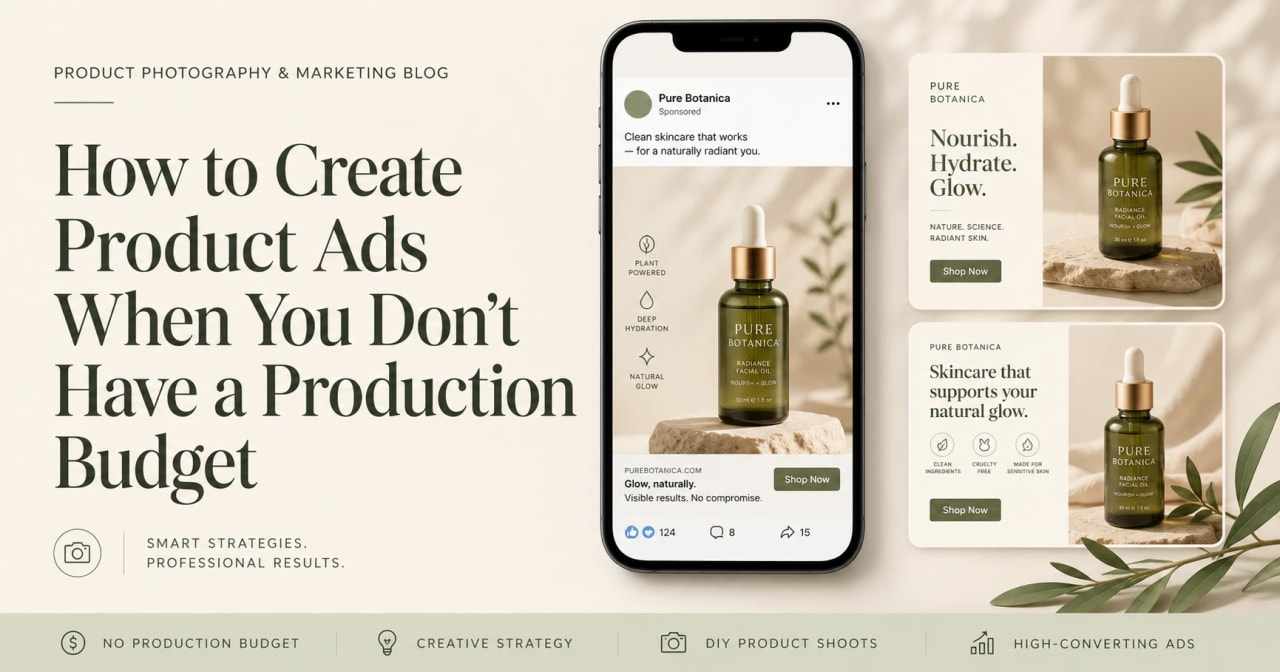
How to Create Product Ads When You Don't Have a Production Budget

How to Create Product Ads When You Don't Have a Production Budget
You have a product that sells. You know advertising works. But to keep your ads running, you need fresh creative constantly — and producing that creative the traditional way costs more than you can justify.
This is one of the most common and most expensive traps in ecommerce marketing.
Ad creative fatigue is real. Audiences see the same image multiple times and stop responding. Your click-through rate drops. Your cost per purchase climbs. You need new creative. Fast.
Booking a shoot takes weeks. Running one costs hundreds or thousands of dollars. By the time the new photos arrive, you have already spent the testing budget trying to keep the old ads alive.
There is a better way to build a creative production system — and it does not start with booking a photographer.
Why Ad Creative Eats Budgets Faster Than Most Brands Expect
When brands first start running paid advertising on Meta, TikTok, or Google Shopping, they often produce one set of product images and run them across all campaigns.
That works for a while. Then the numbers start to slide.
Creative fatigue happens fast — sometimes within four to six weeks on active ad accounts. The same image shown to the same audience too many times stops generating results. The algorithm starts spending your budget on harder-to-reach audiences. Your cost per click rises. Your return on ad spend falls.
The fix is new creative. But producing new creative the traditional way requires:
- Booking a photographer or videographer
- Organising a shoot day
- Waiting two to four weeks for edited files
- Repeating this cycle every month or two
For a brand spending a few thousand dollars per month on ads, this production cost is often a significant percentage of the total budget. For a smaller brand just scaling up, it can be the single biggest barrier to growth.

What Makes a Product Ad Actually Perform
Before looking at solutions, it is worth being clear about what actually drives ad performance.
The single biggest variable in a paid ad is the creative — the image or video the customer sees before they read a single word. Studies consistently show that the creative accounts for 60 to 70 percent of an ad's performance. The targeting, the copy, the offer all matter — but the image or video is what stops the scroll.
High-performing product ad visuals share common traits:
- The product is the clear focal point — not competing with a busy background or excessive props
- The image is high resolution and looks professional at small sizes (most ads are viewed on mobile)
- There is a clear, immediate emotional signal — premium, warm, energetic, trusted — that matches the brand
- The composition is intentional: the eye goes to the product first, then to any supporting context
- Lifestyle shots show the product in use, giving the customer a reason to want it
Most brands with underperforming ads are not failing at targeting. They are failing at creative. And the solution to that is not more testing — it is better images.
The Traditional Path and Its Limitations
The standard advice is to hire a creative professional and run regular shoots. This is correct advice if you have the budget and the lead time. The problem is that most growing brands have neither.
A full ad creative shoot typically involves:
- Creative brief and pre-production planning
- Photographer or videographer fee
- Studio rental or location cost
- Props, backgrounds, and styling
- Post-production and editing
- Multiple revision rounds
By the time everything is accounted for, a meaningful creative refresh costs considerably more than most brands budget for. And once it is done, the clock starts ticking on creative fatigue again.
The other challenge is speed. If an ad stops performing and you need new creative this week, traditional production cannot deliver that.
How Brands Create Ad Creative Without Traditional Production
The alternative is a production method that starts with what you already have — photos or samples of your product — and builds complete, advertising-ready visuals around them.
Here is how it works in practice:
Step 1: Define the ad brief Before any visual is created, the goal is defined. What platform is this for? What is the objective — awareness, click, purchase? Who is the target customer? What is the main message the ad needs to communicate?
Step 2: Provide your product reference You supply clear images of your product. These can be taken with a smartphone on a plain background. They do not need to be professional — they just need to be clean and in focus.
Step 3: Ad creatives are produced Complete advertising visuals are built around your product — lifestyle compositions, clean product shots, multi-format versions for Stories, Feed, Reels, and banner placements. Each is produced to the exact dimensions and quality standards of the platform.
Step 4: You receive ready-to-launch files You get a complete set of ad-ready creative files within days, not weeks. No production delays, no coordination overhead.
This approach does not replace creative strategy or good copywriting. It solves the specific problem of not being able to produce high-quality visual assets quickly and affordably enough to keep an active ad account fed.
Practical Use Cases
Launching a new product You have a product arriving in two weeks and need ad creative ready for launch day. Traditional production cannot meet that timeline. A brief-to-delivery process that takes three to five days can.
Refreshing fatigued campaigns Your top-performing ad has been running for six weeks and performance is declining. You need three or four new creative variations to test. A rapid production cycle gives you those without a full shoot.
Testing different hooks You want to test a premium lifestyle image against a clean white-background shot against a close-up detail image. Producing three variations from one product reference takes days, not weeks.
Seasonal campaigns You need Christmas, Ramadan, or back-to-school versions of your product visuals. Each season requires a different background, lighting treatment, and styling. This can be produced rapidly for each campaign period.
Key Advantages
Speed: Creative can be produced in three to seven days from brief to delivery.
Cost: The per-image cost is significantly lower than a traditional shoot, particularly for multi-format projects.
Volume: You can produce more creative variations, which means more to test, more that will find an audience, and less creative fatigue risk.
Consistency: All your ads can maintain a consistent visual standard and brand identity across campaigns, seasons, and platforms.
Limitations
This approach produces high-quality static and video ad visuals. It is not a substitute for campaigns that require specific talent — for example, if your brand's creative direction requires a named personality or a highly specific real-world location.
The quality of the brief matters. Clear direction about the target customer, the platform, and the visual tone produces better results than a vague request. Coming into the process with a defined brand aesthetic speeds things up significantly.
FAQ
Conclusion
Ad creative should not be the bottleneck in your marketing. When it takes weeks and significant budget to produce new visuals, brands hold back — they run the same creative too long, they under-test, and they accept declining performance rather than investing in the refresh they need.
A faster, more affordable production process means your ad account stays active, your testing stays consistent, and your creative does not become the ceiling on your growth.
Start Building Your Ad Creative Library
Or explore:
Ready to Elevate Your Brand's Visuals?
Stop losing sales to poor product photography. Let's create stunning, high-converting AI visuals for your next campaign.